2011年5月31日火曜日

Thinking of a soul


Nan-en-do Hall (南円堂)is located at the southwest corner on the temple ground of Koufukuji, with octagonal shape and a Kannon statue, Goddess of Mercy, inside. The statue, holding a net called kensaku(羂索) with her hand for salvation, is a national treasure, and is sitting in the behind of the reddish door which is seldom opened.

At the next to this Hall, there is a small hall where an another statue, Hitokoto-kannon(一言観音)( Goddess for one wish) is situated.


I came here for prayer. I wanted to pray for an acquaintance who had departed from this life, for peace of his soul.
Praying I thought that his soul had been already in peace.
When I came to know that he had passed away, I had no tear as if my body rejected to accept the reality, while I felt that my soul accepted it slowly and quietly.


In front of the small hall, there is a small trellis for wisterias. The flowers of wisteria have gone and through the green leaves I could see sunshine in the afternoon after a couple of rainy days. I looked up at the sky thinking of a soul.

When I came here last time, my husband offered a long prayer for the One wish goddess, I remembered.


われよりも長く拝みて礼(あや)をしぬ 夫は一言観音さまに

After prayed

for longer than I have done

my husband bowed from the waist

at the Kannon statue

for One wish


Doves are flying away....
Where do you make streak for? There is no hurry. Never hurry.

2011年5月18日水曜日

Closed Up


Can't you see a vast poppy field through this photo? If you can, I'm very happy, but actually this is a photo of a pot of poppies which I planted seeds, as you can guess easily.

I took this closed up photo thinking of Akiko Yosano's famous tanka that she composed in southen France, I don't know exactly where it is, viewing
a field full of poppies.


ああ皐月(さつき)仏蘭西(フランス)の野は火の色す
君も雛罌粟(こくりこ)われも雛罌粟(こくりこ)( 与謝野 晶子)

( Oh, how fantastic this May is!
We are both here in France, on the field of colour of fire.
You are one of the plenty of coquelicots. And me, too )


Akiko Yosano (1878~1942)(与謝野 晶子) was a writer and a poet, besides she wrote a lot of tanka poems with Tekkan Yosano(1873~1935)(与謝野 鉄幹) who became her husband after he divorced. The two of them had twelve children together.


Akiko and Tekkan organised an association for poetry and started to publish magazine maned "Myojyou"(「明星」 明=bright 星=star) in 1900, and the passionate style of expression of their poems complied in it had quickly become a mainstream of the field of literature and was called Romanticism, which became popular in Europe about 150 years earlier than in Japan.

The tanka which is noted above was written when Akiko visited Tekkan who went to France for climbing out of his doldrums. She was truly a great accompanist for the earnest runner.


たんぽぽとおなじ高さにみておればチェルノブイリか春のかげろう
                                                                                           永田 和宏
(I lie on a spring ground and see dandelions being as high as they are.
Is it air turbulence or something of Chernobyl disaster ,
rising up behind of them, in a distance?)

This tanka was written by Kazuhiro Nagata( 1947~)who is a tanka poet and a scientist, and it is set in his the fifth tanka book, 「華氏」( Fahrenheit).
In the postscript of this book, Nagata mentions that he realised that he got used to feel the temperature as measure of Fahrenheit in US, during his sojourn with his family to study science.


This book was published in 1996, ten years later since nuclear meltdown at Chernobyl happened.
I think the tanka I wrote down above was composed in Japan after he returned from US.
I don't intend to say that Nagata predicted the same revel of disaster would occur at nuclear power plants in Japan.

What I wonder is how his experiences in different culture effected upon his poetry.
Through this tanka he gives us a message with a sight of being closed up and of defamiliarization that might come from some living experience of him, mentioning not only as his knowledge but as his sensory temperature.

What can you see in the distance?


2011年5月2日月曜日

First of May


About fifty days have passed since the northen area in Japan was attacked by unprecedented earthquake and Tsunami.
Recently flowerage of cherry blossoms in the district was on the news.
As thousands of people are living as evacuates, many of them might have seen the blossoms only on TV, or from far away.

What have I done for them? Just economise of possible amount for consecutive donation, so far.
It is somehow dazzling to see on TV people who are working voluntarily to help restoration in the disastrous area to the utmost of their ability.

Out of the window green leaves are shining in the Sun of May.
Sun shine is merciful for everyone and for everything.


Oak tree started to have young leaves. The leaves that just have come out look like tiny birds which try to learn how to fly, and they grow close together so rapidly.
May, it is leafy season.


Grown up oak leaves look thick and robust, though it is transparent like some peaces of paraffin paper when sun rays come though.
And they whisper each other when they touch with breath of wind.

I used to imagine some unknown words for me listening to their whisper.
I feel that so long time has passed since I wrote a tanka as the following.


Such a greenhorn I was.

まだ誰も聞かぬ言葉のあるならむ 若き青葉の零すささめき


Green and fresh leaves
are whispering
just like they let trickle their whisper from the tree
like unknown words for anyone


In Japanese language, words is ”kotoba”(言葉)(葉 means leaves).
In olden days people sometimes used the word koto-no-ha(言の葉), while words do not directly regard to leaves but leaves seem to represent some variety and plenitude.


On the ground, Saxifrage stolonifera(雪の下)is ready to have their little white flowers.

I wish this lovely season will last for a certain time.

Today when I turned on my radio "First of May"「青葉のころ」 was on air.(You Tube)
Listening to this fresh song, I thought I'd like to keep my desire for unknown and untold words in my mind.

2011年4月19日火曜日

black-and-white photographs


black-and-white photographs


There are two black and white photographs that I treasure as shining souvenir ,taken by an American photographer, Ansel Adams. (1902~1984)

One of the two is taking two of dog wood trees in a forest.

from web site


In this photo the dog wood trees are giving a glimmer of light in a dark forest.

It is said that dog wood trees came to Japan in 1915 for exchanging with cherry trees that mayor of Tokyo sent to US in 1912.
In Japan they are generally planted along streets or in gardens, besides in US where the trees came from, many of them grow wild.

Several years ago I had a chance to visit Yosemite National Park in US, famous for rocky mountains represented by Half Dome that was shaped during Ice Age, and falls, Yosemite Falls, Bridalveil fall and so on which have abundance of water especially in April, there I saw many wild dog wood trees were covered with boom. Many were much taller than those in Japan and they had their glorious flowers on the high branches.

Ansel Adams' museum is in the huge park that makes it look tiny.

Dog wood is called Hana-mizuki in Japan.

This is my favourite tanka poem by contemporary tanka poet.


青春は水木のしたをかよう風 あるいはとおき線路のかがやき
                                高野 公彦

( Adolescence, it is a breeze which comes and goes beneath a dog wood tree, or is a mail off shining of silver train tracks Kimihiko Takano 1941~)


In the tanka poem, Takano doesn't mention any substance of youth but floral-fresh breeze
and far-flung shining of rail road.
Thinking of it I remember the very short period time of staying at the magnificent park, Yosemite.
Definitely I was several years younger than I am.


The other one is this.
I've heard that Ansel Adams was influenced by the painters, impressionists, who brought their canvas into the sunshine from their darker ateliers, and depicted subtle change of sunlight on objects.


via here
The little prince in "Le Petit Prince " by Saint-Exupéy saw one day, the sunset forty-four times , rawing back his chair by inch on his small planet.
The sun in this photo might be going to set in, though I keep me it in suspence whether it is rising or setting in, because to see the sunset many times is too sad.


モノクロームの大樹の向こう のぼるとも沈むとも見え白き太陽

The sun shining whitely

over a large-boughed mighty tree

looks setting in

and also rising up

or going to do in parallel (haricot)


I see the photos again and I feel the fragrance of that April.

2011年4月6日水曜日

Ode to cherry blossoms ( sakura )

振り向かば枝にはじけて開くらむ さくらさくらは夢に見るごと

Cherry blossoms will burst out blooming

on each of the branches

as though I will see them in a dream,

      if I'll look back just now (haricot)


Once a cherry blossom starts to open up, all of blossoms will be at their peak before long, and it gives us somehow unreal state of mind.


And, even when people undergo their hardship, looking up to see these transient blossoms brings brightness into their hearts and appreciating their short lives makes people feel special sentiment.
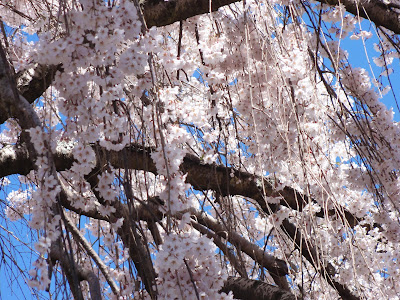


Cherry Blossoms ( sakura ) have been one of major material of Tanka poem from ancient days in Japan, e.g. being expressed in "manyo-shu"The Anthology of Myriad [Ten Thousand] Leaves, compiled in the 8 century. And of course it is still continuing to be written suggesting some theme in genre of modern tanka.


In this time of year I often remember a tanka composed by Kanoko Okamoto(1889~ 1939), about 100 years ago.


桜ばないのち一ぱいに咲くからに生命(いのち)をかけてわが眺めたり

岡本 かの子

       ( As cherry blossoms bloom their full of lives with all the strength they have, I gaze them with my tremendous dignity and utmost power of my life.)


( image from website)


This tanka expresses not only nature of cherry blossoms but also Kanoko's passionate life. I've ever read that when she faced with her quite difficult situation, her partner and a cartoonist, Ippei Okamoto, let her intimate two boyfriends live with them to encourage her. Their intense way of living exerted influence on their youngest son, Tarō Okamoto, by necessity.


As an avant-garde painter,Tarō Okamoto designed 「太陽の塔」,( Tower of the Sun ) for a symbol tower of world exposition that was held in 1970 in Japan.


This year(2011) is 100th anniversary of his birth.


(image from website )


Ten years later of the event, so-called "Bubble economy " term started and it lasted nearly a decade in Japan. In the midst of the bubble economy, Machi Tawara(1962~ ) who is a forefront of colloquial tanka poem wrote about transient nature of cherry blossoms like this.


さくらさくらさくら咲き初め咲き終わりなにもなかったような公園

                       俵 万智

          ( Sakura sakura, their floral term broke out and came to an end,

then the park stays totally as it used to be.)


Since the period of bubble economy terminated, in Japan people have struggled with prolonged recession.

And now, aftermath of the unprecedented earthquake and tsunami, including trouble of leak of radioactivity from power plants, makes people get to grips with new phase of difficulties.


New term of challenge ourselves has begun.

2011年3月24日木曜日

Prayer


My husband , my second son and I visited our family's grave on March 20Th,one day earlier of the spring equinox day, as one of family events, as weather forecast said it was going to rain on the following day.


According to Buddhism, it is said that on the spring equinox day people pray praising nature and for living people, besides on the autumnal one they pray for ancestors and the deads' souls.

I don't think so many Japanese are serious believers of Buddhism,including my family, though there are many who visit their family graves on the day of both of equinox.

This time I also couldn't help praying for numerous disaster victims by the biggest recorded earthquake and Tsunami unleashed by it on March 11Th in northen area in Japan.

There are often snow damage in some parts of the area, and they got hit by the devastating disaster when the long winder is at last going to over.


Our grave yard is located to near a temple, Byakugou-ji(白毫寺), where we dropped in.
This small mountain temple is famous for a camellia tree that has five different coloured flowers, red, white, pink, white with red stains and red with white stains, as a result of graft in the tree.

Unfortunately the buds of it are not yet loosen, though some other sorts of camellia blossomed out in various ways.


And a sort of cherry tree, Kan-zakura, which flourishes in a cold season"Kan", had some white serene flowers.


雪消(け)ぬとう訳にはゆかぬ北方の被災思えり寒桜咲き

A cherry tree has its flowers like some snow flakes

in a cloudy morning

that let me think about the sufferers in the boreal

whose untold disasters are like huge icy rocks


It is my sincere wish that a speedy restoration and support will bring back the victims their peace and normal days sooner.


2011年3月10日木曜日

Nocturnes


The vernal equinox is getting nearer and the day has lengthened cock-stride day by day.


隣家との境に草の花あおく きのうより少し長い夕暮れ

Some growth of weed
has its tiny sky blue flowers,
They are still clear
as dusk is a little longer today
than it was yesterday
(haricot)


Recently I reread a story in "Nocturnes",published 2009, which I read just in this season of last year. It is written by Kazuo Ishiguro(1954 ~), consisting of five short stories, regarding music, love, and the passing time, as though they are packed in a music album.


The story which I reread is the second, "Come Rain or Come Shine".
This one is like a light music, a little up-tempo, compared to the tune of other four stories.


Charlie, Emily, and the narrator Raymond are life-long friends since they were university students in London, mainly had shared their time on talking about music.
Charlie and Emily got married and stay in London. Besides Raymond is a sort of nowhere man who is teaching English in Spain as of now.


One day Raymond was invited by Charlie and was asked something about a favour for him, for passing time with Emily while Charlie's absence for a couple of days on his business. Raymond, hesitating to do the offer, admits the reason that he is the oldest friend for them.

Some fiddle things gradually tell that something wrong with Charlie and Emily, then Raymond starts to have knot on his stomach. He struggles to solve something invisible, though his clumsiness seems to make things worsen and tighten the knot. And then...


I will watch the dance of tea leaves for a couple of minutes, remembering the last scene of this story.

Dusky light is getting to ebb.


P.S.
Emily and Raymond had been preoccupied by their own matters ,then suddenly she noticed that theirs were somehow overlapped.

She invited him to dance with her on the balcony of nightfall and they did dance as though it would win back their mutual subtle misunderstanding, and even would make up for the lost time.


"Come Rain or Come Shine" You Tube