2011年10月12日水曜日

Some pieces of memory


Recent warm autumn days are better suited for going out for walking or doing some sports. In fact when I'm passing by some schools I can see exercise for athletics meets by students.

Besides autumn makes me feel tempted to make some small thing sitting alone in my room thinking of something or nothing.


Of course making or reading tanka poem makes my day, but today the pieces of some old cloth which I found at a corner of my drawer gave me a hint.


They were given by my husband's mother ( I don't like so much the word, mother-in-law), and have been forgotten.
The pieces of cloth are of indigo dyeing and the patterns of the cloths are chrysanthemums and tiny butterflies.


I tried to do patchwork simply by hand.
And I added some tapes and spangles which are not so standing out.

Maybe it is simple crazy patch if I can name


Doing this, my memory traced back the days where I had lived with  my husbands mother.


They were not always bright days, and sometimes rainy, but all peaces of the memory are so tender.


 窓の外にくだるは露か夜しぐれ
                         ひそやかにして何か近づく


               斎藤 史(1909~2002)


Is it dewfall or

night's passing autumn shower

on the windowpane?

Stealthily, without a sound,

something is approaching here
(translated by James Kirkup and Makoto Tamaki)

Like dewfall in the tanka by Fumi Saito, tenderness of the memory came stealthily to me.

While I am unaware some autumnal insects started to be chirping.


I made this cushion last autumn listening to some sings of insects.


By the way the mother leaf that I posted here had four children.


And they are growing like this.

2011年10月2日日曜日

Tea Ceremomy in a temple

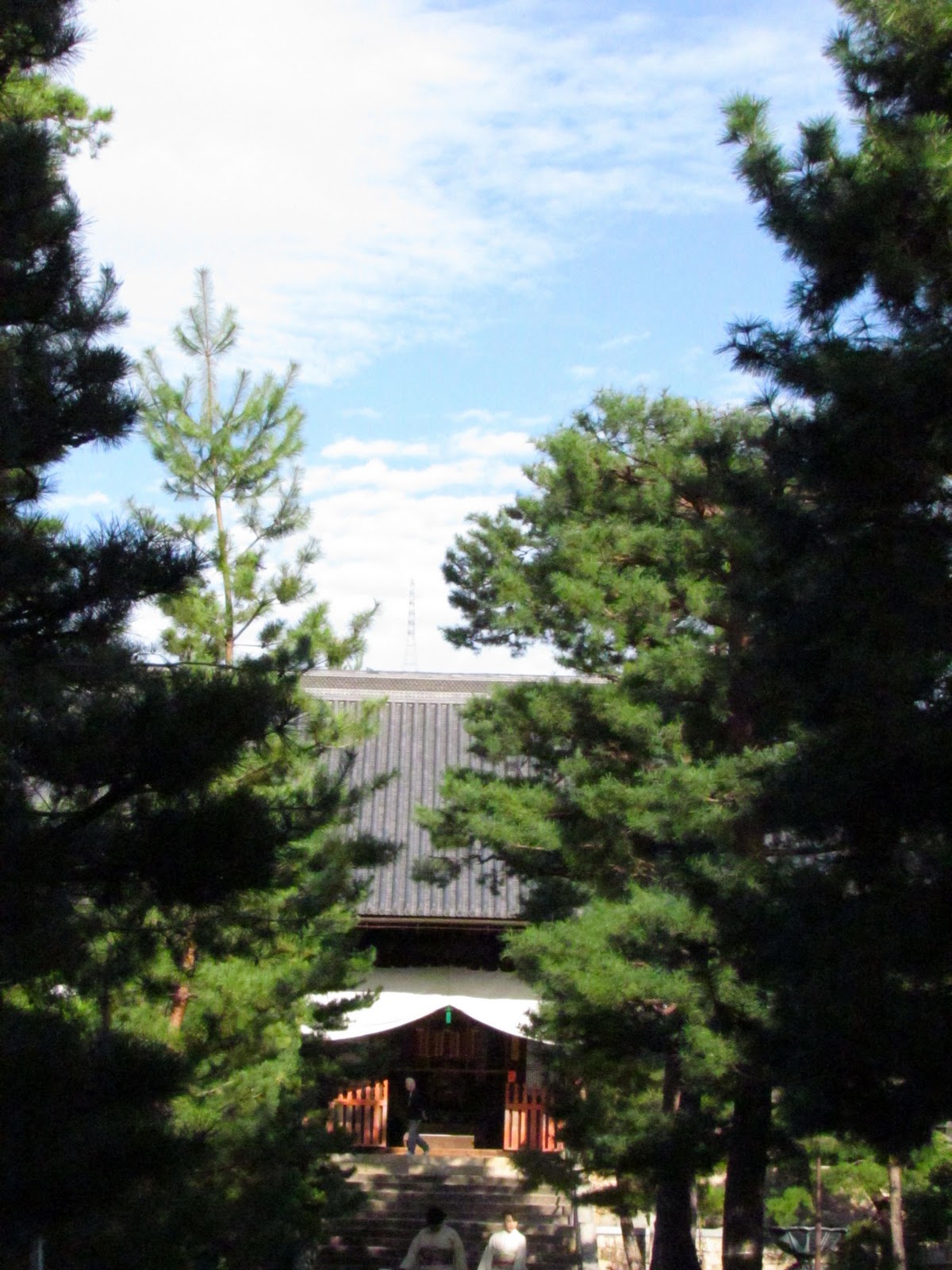
On Oct. 1. tea ceremony by many schools was held  in a temple, Manpuku-ji(萬福寺).
 A friend of mine got the tickets and invited me to attend there.
 Tasting tea in this good season and that the event is for viewing moon with a cup of tea if we would be lucky were too attractive to resist.


This temple is located in Uji-city in Kyoto prefecture where green tea is special product, and was built about 350years ago.The main hall has not been rebuilt since then.


Main hall

from one of the other smaller halls


The scale of the temple precincts is vast , though I did not see so many priests nor monks there. He is one of them whom I saw a few and his youth reminds me of a sensational tanka of the following by Akiko Yosano ( 与謝野 晶子1878~1942).


やは肌のあつき血汐にふれも見でさびしからずや道を説く君
Rather than trying


to touch the burning passion


pulsing beneath my soft


pale skin, you preach morality.


Aren't you awfully lonely?

I found this translation by Sam Hanill and Keiko Matsui Gibson in a book "RIVER OF STARS" that GABRIELA told me in her comment on this blog.


I'm enjoying this book. Thank you GABRIELA.


Serving green tea called sencha started at 15:30.
We arrived at the temple around 16:00
Sencha(煎茶), a sort of green tea (茶=tea),  improved its manner for service in each of several  sencha schools after the original one came from China.


Some schools set up tables on the ground here and there and some do inside of the halls for serving green tea.

Guests and visitors come one after another and wait until the previous series of service will have finished.

The circuit was continued until 20:00, and we stayed there until 18:30.
We enjoyed tea of three schools, though I couldn't distinguished the difference of the subtle taste.
I need to learn more.


in front of the main hall, ritual-like tea ceremony is ongoing


hanging lanterns on the ceiling of the cloister


Can you see the letters sencha (煎茶)on the hanging lantern?
Actually it is written that the letters sencha-dou
(煎茶道).
道 means way, and it suggests that  to learn something is like a long way.


Seeing and tasting is learning,


I will try to make better tea from now on.


my mother-in-law's heirloom


2011年9月19日月曜日

Higan-Bana (cluster amaryllis)

Before arrival of another typhoon my husband and I went to see cluster amaryllises which can be seen around a temple known as Buturyu-ji (佛隆寺), which is located at south east from my residence.


I took my dog.It was about 90minutes drive, and then many cluster amaryllises loomed into view.
They seem to be countless.


Many hikers and photographers were climbing the staircases slowly, and the scarlet flowers were almost in full boom on both side of the staircase which consists of about 200 stairsteps.


The flowers have multiple names, Manjyu-shage or Manjyu-shaka(曼珠沙華), and Higan-bana(彼岸花), and as English name, cluster amaryllis and spider lily, and its scientific name is Lycoris radiata.


Among the names I'm familiar with is the name, Higan-bana, not only because they bloom around Higan(equinox)  in autumn, but also they look like they are blooming on the border of this world and another world ; Higan means "another world ".


This seasonal flower reminds me of this tanka poem by Sumi Konnno.

夏ゆけばいつさい棄てよ忘れよといきなり花になる曼珠沙華  今野 寿美(1952~)


They are fierce red Manjyu-shage

out of the blue

as if they say summer's gone

for setting aside and forgetting

without any restraint


However, I cannot figure out exactly what she suggests through this expression.

I understand well the fact that the flowers come out without leaves and it makes us feel abruptness, but she tells us that we should forget...what events in summer or any hot flavor, or love to pine after someone...?

To tell the truth I like this tanka without any specific reason.


On my way to go back I realised that  it's  in the middle of harvest season.
Autumn equinox waits just around the corner.

2011年9月7日水曜日

Small change to autumn

Some moderate change of the season around me gives small but remarkable findings sometimes.


Some small fruits of Callicarpa japonica, Murasaki shikibu in Japanese that was taken after the name of author of The Tale of Genji , are going to turn into white from green, and from white to purple.


In autumn we have rainfall including that of typhoon once in a while, and it tends to last a couple of days.

 In fact the last typhoon showered 2,400mm during four days regionally ( southern part of Nara prefecture and Wakayama prefecture).
I offer my condolences for the people who suffered damage.

 It was not a small change at all. On seasonal matters ,not so big change must be a lucky one.

 A tiny spider ,which is up side down , looks floating in air and aiming the watery sky instead of waiting for his prey, before the arrival of the typhoon.


It cleared up at last.


Textoria trifida , Kakure-mino in Japanese, blooms without any particular distinction,
though a little butterfly found it. We can see some sort of butterflies until late in autumn.

Before, I made this tanka when I saw a butterfly in cooler season.


石の上にとまりてをりし砂色の蝶飛び去りぬ 背中が寒い


A sandy little butterfly

on a stone flew away

and has gone,

I felt faint cold on my back

like the butterfly flew away


My neighbour's dogwood tree began to bear some red fruits, while some of them are still whitey.
The red ones are starlings' favourite and they will be gone sooner by the birds who were waiting for their riping.


My neighbour gave me some seeds of Cardiospermum halicacabum, Fūsen-kazura in Japanese, which has many orange coloured tiny paper balloon (fūsen)-like flowers during summer.


Each has a white heart mark on it.

I will check the suitable season for sowing the seeds.


2011年9月2日金曜日

Mother Leaf

The other day I noticed a pot for a plant with familiar leaves on my way to a temple where my deceased father and mother used to visit often.


I asked the owner to give me one of the leaves.


More than five years ago I found a leaf in a variety goods shop.


The shop keeper told me that the leaf came from Ogasawara Islands (Bonin Islands) that consists of main four islands called Iwo island ( it became known as the movie "Letters from Iwo jima"), Nishi-no-island, Father island, and Mother island, which are located southern area .

She told me the name as well. It was Mother leaf.


I bought it (100yen per a leaf), and put it on water in a small tray as the shop keeper told me.

About one week later it started to have some thin roots like this photo shows.


And about another week later some baby leaves turned out at the edge of the Mother leaf.


The baby leaves and the roots grow fast, and the mother leaf will start to decade soon.


Before, when I bought the leaf and raised a baby leaf to a plant with a stem,(actually the baby leaf came to have some mother leaves on the stem), I failed to keep it during cold season. The plant seemed to be a sort of tropical one.


This time I'd like to raise it again and maintain the plant carefully during this winter.


I happened to see the plant in a cafe, so I revisited there with a camera.

マザーリーフ繁らせて木々立つといふ父島、母島あを深からむ


They say there are many trees

with many Mother leaves

and it let me imagine the deep verdure

on Father island, on Mother island haricot


2011年8月19日金曜日

events in summer


Obon vacation , in the middle of August to graciously receive any returned souls according to Buddhism, was over.

I enjoyed to have time together with my family and do some events for the season, visiting our family grave yard for example.

And also I'm relieved now that my usual daily life came back for me.


This post is about a part of my passing of time during the vacation.


Just shortly before Obon, it was held that many tiny candles were lit on the field of Nara Park. It creates a feeling of welcoming returned souls with lightning about 20,000 candles totally, on some fields, along the road and in front of a temple, and so on. This event has been held from 1999.


In addition to the commemorating for ancestors and the war dead, that for the victims by the earthquake and tsunami on 3.11 was accounted this year.

百の燭(しょく)を覗きつつゆく 古都の野にうごめく影の一つとなりて

As a shadow

moving on,

I look into a protection

for each of tiny hundreds of candles

on a field of an ancient capital haricot


For my family's ancestors we visited our family grave yard.
My family is not Buddhists but Shintoists ( Shinto is Japanese indigenous religion), though in the grave yard there are tombs for both.( The shape of tomb stone is different: that of Buddhism is rectangular , that of Shinto is pointed at the top, and Buddhists offer flowers besides Shintoists offer green leaves called sakaki.)

And later I called in a Temple, Byakugo-ji(白毫寺), because I like the location of the small temple,although most of Shintoists visit shrines not temples in general.


I like the serene atmosphere of this mountain temple as well.


In autumn it is famous for the flowers named Hagi in Japanese which can be seen the both sides of staircases on the fifth photo.


They were still young, but among them there were some precocious ones which had already some flowers like this.


Maple leaves are also still green hones.


But some are precocious, I found.


In spring this temple is famous for camellias. Some camellia trees bear some solid fruits now.


From this small temple ground, we can view Nara basin widely.


This prospect is one of the big reasons that I 'm fond of this temple.


The mail hall next to the pagoda is under construction
Compared to spring the outlook is clearer due to the air without haze, and it tells us that autumn is just around  the corner.

2011年8月3日水曜日

longing


Walking through beneath the trees...I can see a vegetable garden alongside of a road where I sometimes take a walk with my dog.

In a corner of the garden, some sunflowers are in full bloom.


The following tanka poem was written by Yoko Nagai (永井 陽子1951~2000).

This symmetric verse is so simple that let readers have an indelible impression even after having been read only once.

Simple but I feel something behind her words, and I found that it would be her longing.


ひまはりのアンダルシアはとほけれど とほけれどアンダルシアのひまはり

Although Andalusia of

sunflowers

is a far field;

Though it's faraway,

Sunflowers in Andalusia


Before, I read in some article about the word,longing, and the implication of it.

Longing is "a-ko-ga-re" in Japanese: a(吾)= I,  ko(此処)= here, gare(kareru(離れる)=leave.

That is to say, longing is to leave the place where the person is.

Some people start to travel leaving the safe refuge feeling a compulsion of longing for somewhere else.
And also, there are some cases that something like soul starts to travel with longing for somewhere else from someone who are staying there.

The case of the tanka poem by Yoko Nagai goes for the latter.
And the feeling that readers can read the between the simple lines is travelling of her soul, I think.


I have longing for some unknown place or country once in a while, besides I wish my daily life would be over without any mishap.


The sun will set in behind my neighbour's roof, and on the mountain I can see over the roof they will light soon for those who will be there for enjoying cool evening breeze.


山肌にケーブルカーの道点り 連なる灯り滑りてゆけり

The trail for the little cable car

also being lit up,

Chained lights 

are sliding down

on the mountain surface (haricot)