2012年10月11日木曜日

Autumn flowers and walking

Rokkō alpine botanical garden is on Mount Rokkō, one of a group mountains in Hyogo prefecture.


It was opened in 1933, since then visitors can appreciate variety of seasonal alpine flowers whenever they visit.

Rokkō is not actually a very high mountain,931m at its highest point with fairly steep slope, and the transportation, cable car or ropeway, is so convenient that even children can enjoy climbing and taking a walk on the roads.

It is known that some area on the mountain range developed as a summer retreat by foreign residents in Kobe after Meiji (1868~), and they made some artificial ponds around there.

There are some ponds in the botanical garden as well and they give some significant atmosphere to the garden. So,we can also see many aqua plants and flowers.
It was at the beginning of July when I climbed Mount Rokkō several years ago, and I enjoyed to see many hydrangeas along side of the road to the botanical garden and many summer alpine flowers in it.


This time I realised about season's transition much more than I did at the last time.
Temperature was 14 degrees centigrade which made me feel much cooler than I expected, yet I recognised some fading summer plants like some afterglow.        

Enko-so or Caltha palustris var. enkoso are almost starting to wither, but the golden yellow have not yet lost colour.


Daimonji-so or Saxifraga fortunei var.incisolobata are in full bloom, though the tiny flowers' blooming is so quiet.


The tiny flower looks like a letter of Dai (大), so it derives its name, Daimonji-so, from{Dai(大=big)monji(文字=letter)sou(草=herb)}.
Can you see many Dai(大) letters?


As for naming, Waremokou, Sanguisorba officinalis, has an interesting origin.

Ware(吾) means" I", mo(亦) is "also", and kou(紅) signifies red.

That is to say, it blooms showing "I'm in red, as well".

They are bathing in the clear autumn sun light and exhibit their understated colour.

Viewing and appreciating some flowers and feature of this garden I found joy in just walking.


Walking made me loose my sense of time, and made me feel sound physically and mentally as if I was purified by it.


細かなる山の草花屈みこみ見るとき秋のひかり濃くなる haricot

Bending lower


at the tiny petals of

an alpine flower


I feel the autumn sun light

becoming dense


2012年9月28日金曜日

song of autumn

In these two weeks the temperature became moderate so rapidly,
but again autumn seems to hesitate to visit at a gallop.


However, the weather is suitable for walking even for a people like me who is not sportive.


Walking without worry about insignificant
and small things is refreshing, even more so in clear air under the deep sky.


I walked to a park, admiring the typical autumn flower, cosmos,
and long-termed booming of abelias, faintly reddish leaves and already ripe nuts of dog wood tree.

But I leave something to be desired.
After a rainy night, we had a calmer and more placid morning.

I remembered about the field I happened to see through the train window when I went to Kyoto the other day.

It was close to the border between Nara and Kyoto, more rural than the area
where I live and I thought the field invited me.


Perhaps it reminded me of my childhood, though the area was new to me.


When I was a schoolgirl I walked to and from school seeing such fields.
Some wild flowers and some abandoned ones, spreading golden paddy fields as background, are nostalgic.

I was fulfilled my senses gradually.

When I saw cluster amaryllis I remembered that I was taught they were poisonous, and even that took me back.


At night I found this tanka in one of my favourite books, "In Thickets of Memory", by Fumi Saito.

おのれ孤りおのれの毒を食みて生き女いささか酔ふことありし 斉藤 史
Living on her own,

staying alive by feeding

on her own poison,

a woman at times displayed

some slightly toxic symptoms

translated by James Kirkup $ Makoto Tamaki

Cluster amaryllis has another name, Spider lily.
Remembering the crimson I saw in daytime, I thought of another aspect of life of the bright flower.


2012年9月13日木曜日

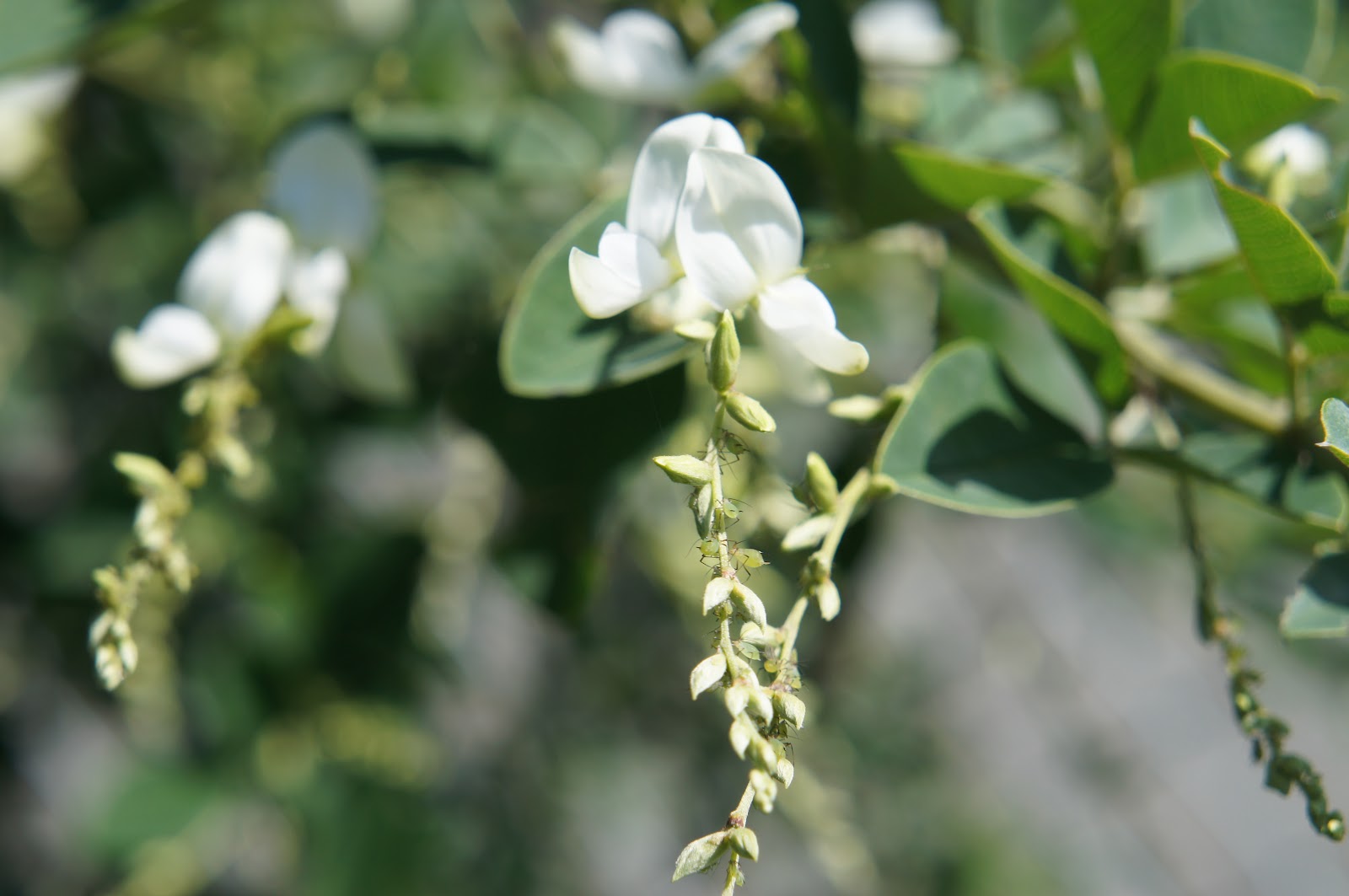
White bush clover and White lily

There was an enthusiastic teacher who taught how to compose tanka(Japanese 31 syllables verse) and its spirit, and there were diligent pupils who learnt with him. Among the pupils the two ladies were quite talented and understood well what the teacher wanted to teach them.


The pupils' names were Akiko(鳳 晶子1878~1942) and Tomiko(山川登美子1879~1909), each of the two was called by her nickname "Shra-hagi"( white bush clover) and "shira-yuri"( white lily)by the teacher , because both of them

responded to expectations by composing excellent tanka poems and by their zeal minds.


The teacher is Tekkan Yosano(与謝野鉄幹1873~1935), who tried to change the stream of traditional Japanese poetry.


Tekkan and his two pupils became more and more intimate, as their ideas and style of their poems became popular.


As the consequence of their situation,Tomiko stepped aside from them involuntarily and Tekkan ended up to remarry with Akiko to start together as leaders of the poetry group.

In a lecture I've heard of that a folklorist and poet, Shinobu Origuchi(折口信夫1887~1953), preferred Tomiko's poets rather than Akiko's over appealing ones.
As Origuchi was interested in the original nuances of Japanese language, he dug deep into them, then it is supposed that his study influenced on his idea for Tomiko's tanka which tended to be introspective about herself and words.

Getting back to their nicknames, I wonder why Akiko, sensational and advanced person on her belief, got such a name of flower which is not so outstanding,
besides Tomiko's name was from fragrant and relatively showy flower.

In their era there might have been more such flowers in the fields, white lilies in spring and bush clovers in autumn.


Regarding to lilies of ecesis, nowadays it is difficult to find them except in some special gardens.
Probably "showy" is my impression on the lilies I can buy at a shop.

On the other hand we can find bush clovers everywhere, in the fields, at the street corner, and on some temple ground and so on, although white ones are much less than reddish purple ones.

Recently two books about Tomiko were published, and her tanka and her life are introduced by some contemporary tanka poets in them.

Her husband passed away suffering from tuberculous just after one year later of their getting married, and she herself suffered from the same disease after she restarted to create tanka poems trying to console herself.

Tomiko's room where she struggled with illness in Obama City


To know about Akiko and her tanka poems is not difficult, for many books about it including translations in English, and Wikipedia in English(here).

In a nutshell, she fascinated many people as a flag-bearer of main stream of Romanticism, while in private life she came to have twelve children and many offspring consequently.


Today I walked in a field of ruin of Nara that used to be the capital of Japan more than 1300 yeas ago.


The story of the two ladies and Tekkan was unfolded about 100 yeas ago.
It seems an old story, but when I think of them walking in this field it appeared to a story of only one hundred years old.
the main building "Daigokuden" was rebuilt recently


黒髪の千すぢの髪のみだれ髪かつおもひみだれおもひみだるる

My shiny black hair


fallen into disarray,

a thousand tangles,

like a thousand tangles thoughts

about my love for you.

Akiko Yosano

(translated by Sam Hamill and Keiko Matsui Gibson)

おっとせい氷に眠るさいはひを我も今知るおもしろきかな 
It makes me feel easier

to get to know that

a fur seal falls into a slumber

soundly and tranquilly

on its icy bed

Tomiko Yamakawa


2012年8月29日水曜日

subtle change of season


The summer heat is yet lingering,while I feel the gradient sun rays especially in early morning and much less cicadas songs came to be heard in day time these days.

In my garden Cardiospermum( フウセンカズラ) have grown and got to bear many seed in balloon- shaped sacs.


typical Japanese paper balloon from website
This plant has another name, Balloon Vine Love in a Puff Heartseed, because each seed has a white heart mark on it.(sorry for not clear of my image for that.)


Some of the sacs have turned into autumnal colour.


And a tiny dragonfly of US has flown across the ocean and arrived here at Japanese house.
He takes a rest now. ( Thank you so much, Jen)


「ラ・メール」に青を重ねてエア・メール花の国からひらりと届く 今野 寿美


An air mail arrived
 
like a floating petal
 
from a state of floral country
 
wearing blue of the sky
 
and reflection of the ocean
by Sumi Konno(1952~)

2012年8月17日金曜日

a river's run


My husband and I took a drive after some family events during Obon (お盆)vacation.

New year holidays, Golden week and Obon are the three long rest and relaxation in Japan.

Among them Obon has a religious meaning that people welcome returned souls and spend time together.


So, each region holds some characteristic events on it, and each family prepares to accept souls of ascendants offering food and some ornaments to Buddhist alter.

As my family is not Buddhist, we simply clean up our family grave yard and spend time with returned sons who don't live with us.

To prepare food or eat out with them are really enjoyable, but the relaxing time goes by with a lighting speed and sooner only my husband and I were left again at home.

  After about three hours drive we reached Kawakami village which is actually located along the kawakami (upper river) of Yoshino river.

The glide is calm and almost no ripple on the surface. By this place there are some cottages for taking hot spring with 39.5 degrees. It is natural recycle system that the used water flows in the glide.


The circumstance is savage that makes me realise that I'm in a village. Retaining walls along the road are covered with moss or some sort of fern.


We had a rest in a cottage and took hot spring. My husband really likes it, while I'm reluctant to take it in summer, but the lunch we had in the cottage was good enough.

On a wall of the cottage I found a painting that depicts how the used hot water pouring into the glide.


    On our way to go back I could see various feature of the river as we went along it by car ; some part of the current is shallow and rapid and the river has many curves.

Before I read such phrase that the variety of the feature of a river makes it enrich, and the invisible destination because of the curves is quite tasteful, something like this. River's run has been sometimes described as a metaphor of man's span of life from ancient times.


After more than two hours drive the water flow is slow and deep, and we can see the mountains far away.

 
  At the place where the river is shallower and there is sand riverbed, some families are enjoying bathing river water.    I remember the summer we went to riverside for a barbecue when my sons were kids.

And, I saw a couple of people who was fishing.    They looked skillful for handling their fishing rods.
Is it an elderly version of "A River runs through It"?

The sun rays have declined. It is already before dusk.


釣り人が腰まで浸かりひく天蚕糸(てぐす)逆光なればしばしば消ゆる
Anglers,


their lower bodies being submerged,

 
are pulling the lines


which often fade away


in the back light (haricot)


2012年8月6日月曜日

on a scorching hot day


I'm suffering a slight injury these days and we are in a long spell of heat wave in Japan.

However, fortunately I can honor the best athletes in the world watching London Olympic on TV, and reading is also quite comforting when I stay at home.
And most of all it is important for me to think about something cooler during such a sultry season.


I remember the day when my husband and I strolled by the bay of Kobe and took a short cruise by a small ship around the bay.  
  After Meiji era( 1868~) Japanese government pried open a country and Japan accepted Western culture and technology aggressively. Meanwhile port of Kobe became one of biggest ports in the world with the rapid expansion of industrial area close to the port.

  Geographical dimension between Kobe and Nara where I live is quite different.


An open environment of Kobe compared to Nara being surrounded by mountains makes me feel refreshing. It mainly owes to the port I think, though we can also see and climb mountains not far from there in Kobe city.


Various sort of sports, baseball, football and so on, were imported from Kobe Port and at first they were played in the enclaves for foreign residents, then extended throughout the
country.


In fact there is a hydrangea in my favourite hand made glass vase in front of me. It is the last flower of hydrangea in my garden.
It let me imagine the massive fire flowers of London Olympic torch which fascinates me, but to think of water seems to be better on such an extremely hot day.


Obama(小浜)which I wrote about in the previous post literally means small(小) beach (浜). I visited the sea shore of Obama waiting an expressway bus for going back.    

As I'm familiar with shores along the Pacific Ocean, the small beach of Obama which faces to Japan Sea looked a little sad for me.


It was just a couple weeks ago, but when I look back with a big bandage on my chin yesterday is like a day of long ago.

   
  I think again about my brother's days after he got a notification of terminal cancer.


He sometimes took a small trip with his family for making good memories, though the hardness in his mind is beyond my imagination.


Here I'd like to try to think about my favourite tanka poem which describes about sea.

海を知らぬ少女の前に麦藁帽のわれは両手をひろげていたり  寺山修司


With my straw hat

I stretched out my arms,

my very best,

for a girl

who has never seen any of the sea

by Shūji Terayama (1935~ 1983)